
What is carpal tunnel syndrome?
The carpal tunnel is a narrow passage on the palm side of the wrist, formed by the wrist bones and the transverse carpal ligament. Nine finger-flexing tendons and the median nerve pass through it.
The median nerve supplies feeling to the thumb, index finger, middle finger and the thumb side of the ring finger, and controls some of the thumb muscles. When pressure inside the tunnel rises, for example from inflamed, swollen tendons or fluid in the tissues, the median nerve is squeezed, causing carpal tunnel syndrome.
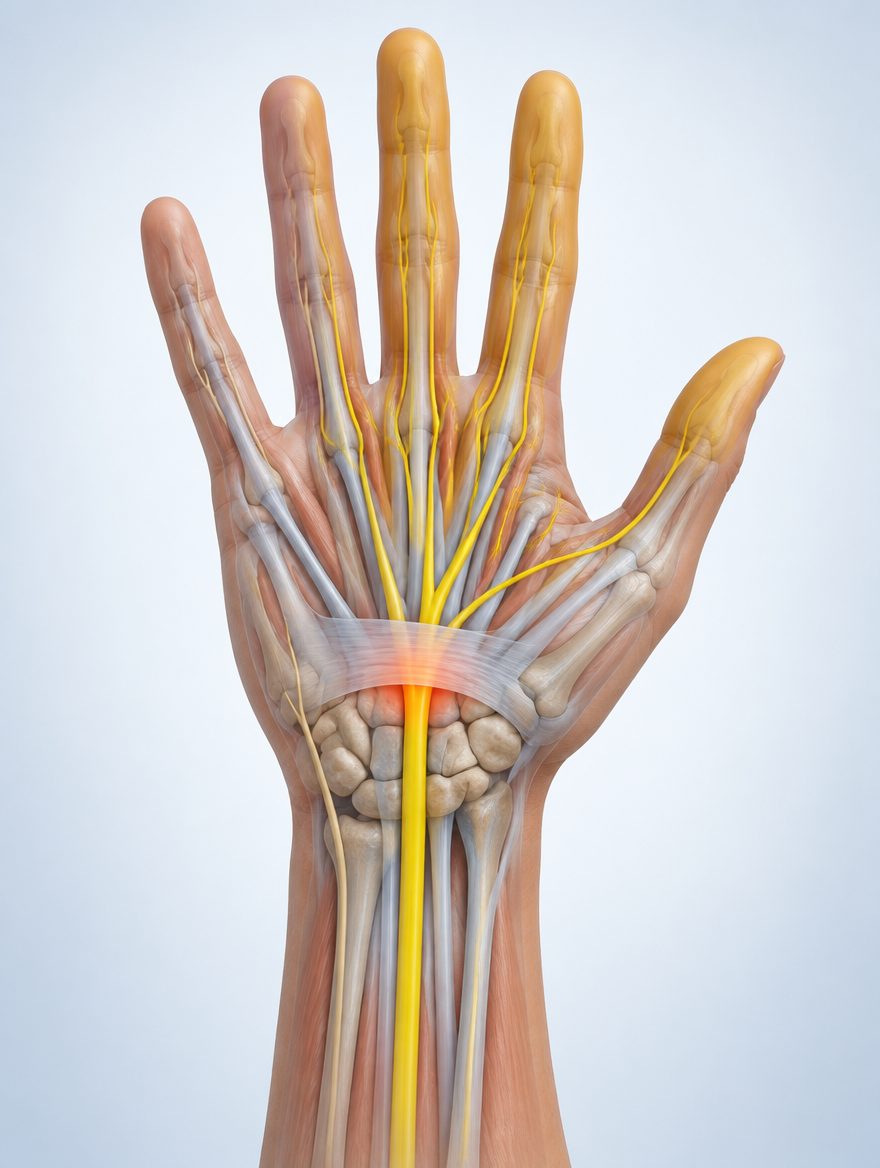
Carpal tunnel syndrome symptoms
Symptoms usually come on gradually. At first they come and go; later they can become constant.
Common symptoms
- Numbness or tingling in the thumb, index finger, middle finger and the thumb side of the ring finger
- Symptoms that are worse at night or on waking, and ease when you shake the hand
- Numb fingers when using a phone, typing, driving or holding things
- A weaker grip, dropping things, or difficulty doing up buttons and picking up small objects
- Fingers that feel swollen even though they don't look swollen
How it progresses
It usually progresses in these stages:
- EarlySymptoms come and go, mostly at night or early in the morning, and fade after shaking the hand.
- MiddleNumbness also appears during daytime activities, and the hand becomes less nimble.
- LateNumbness no longer goes away, the thumb is weak, and the muscles at the base of the thumb (the thenar muscles) may waste.
Symptoms don't always follow this order, and both hands can be affected.
Causes and risk factors
Carpal tunnel syndrome usually results from several factors together rather than a single cause.
- Repeated or prolonged wrist bending and forceful gripping, such as typing, using a mouse or phone, or housework
- Regular use of vibrating tools
- Fluid retention in pregnancy, especially late pregnancy
- Diabetes, an underactive thyroid and rheumatoid arthritis
- Hormonal changes around the menopause
- Wrist fractures or other injuries
It is more common in women and in people aged 40 to 60.
Self-checks
These two simple tests can give a first indication, but they cannot confirm a diagnosis.
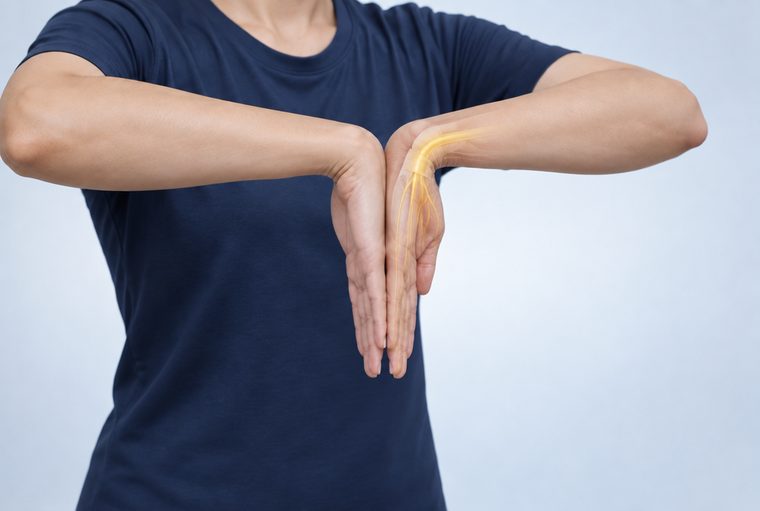
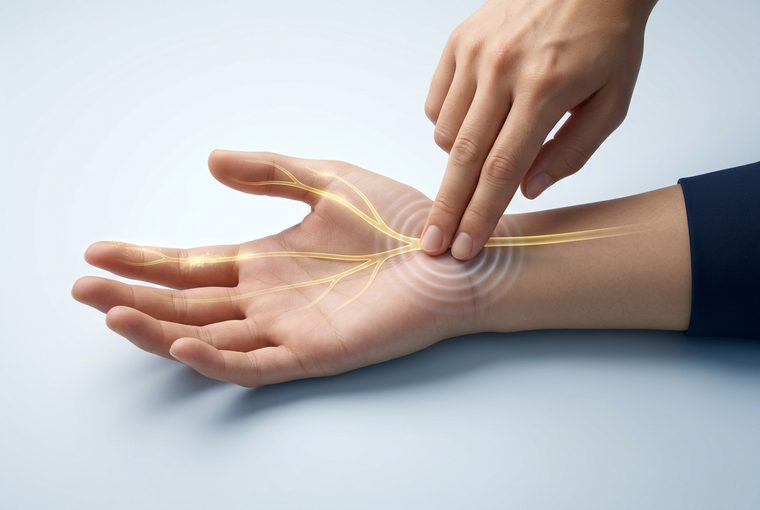
A positive result does not mean you have carpal tunnel syndrome, and a negative one doesn't rule it out. If symptoms keep coming back, or affect your sleep or work, have them properly assessed by a healthcare professional.
Finger numbness isn't always from the wrist
Finger numbness has several possible causes. Finding where the nerve is being compressed is the key to choosing the right treatment.
Carpal tunnel syndrome (median nerve compressed at the wrist)
- Where the numbness usually is
- Thumb, index finger, middle finger and the thumb side of the ring finger
- Other clues
- Worse at night; the little finger is usually spared
A trapped nerve in the neck
- Where the numbness usually is
- Depends on which nerve is affected; can involve the thumb, index or middle finger
- Other clues
- Often comes with neck or shoulder pain that travels down the arm; may get worse when you turn your neck
Cubital tunnel syndrome (ulnar nerve compressed at the elbow)
- Where the numbness usually is
- Little finger and the little-finger side of the ring finger
- Other clues
- Worse when the elbow stays bent for a long time, such as holding a phone to your ear
Peripheral neuropathy (for example from diabetes)
- Where the numbness usually is
- Both hands and both feet, over a wider area
- Other clues
- Symptoms often start in the feet
Sometimes the same nerve is compressed in two places, at the neck and at the wrist. This is called a “double crush”, and treating the wrist alone may not be enough. That is why Dr. Ho assesses the neck, shoulder, elbow and wrist together.
Further reading: Neck pain, Herniated disc.
How it is diagnosed
Diagnosis relies mainly on your history and a physical examination, with a nerve conduction test when needed.
Your history: When and where symptoms appear, and your work and hand-use habits.
Physical examination: Testing finger sensation and thumb and hand strength, plus provocative tests such as Phalen's test. The neck, shoulder and elbow are also checked to rule out other causes.
Further tests: If a diagnosis needs confirming, or the severity of nerve compression needs assessing, Dr. Ho can refer you for a nerve conduction study. Where needed, he may also suggest imaging such as ultrasound, or refer you to an orthopaedic doctor.
Carpal tunnel syndrome treatment options
Treatment depends on severity. Mild to moderate cases usually try non-surgical treatment first; surgery is considered if nerve compression is severe or keeps getting worse.
Non-surgical treatment
Changing hand use and ergonomics: Reducing prolonged wrist bending and forceful gripping, and taking regular breaks.
Night splint: Holding the wrist in a neutral position during sleep may help ease pressure on the nerve. Splints are generally available from pharmacies or orthopaedic supply shops, or can be fitted by a healthcare professional.
Nerve and tendon gliding exercises: Specific movements done under guidance, aimed at helping the nerve and tendons glide smoothly through the carpal tunnel.
Hands-on and soft tissue treatment: Releasing tight tissues in the forearm and wrist, which may help improve wrist joint movement.
Shockwave therapy: Some studies suggest shockwave therapy may help mild to moderate cases.
Ultrasound therapy: The research evidence is more limited; it is generally used only as a supporting treatment.
Treatment prescribed by a doctor
Medication or steroid injection: May ease symptoms in the short term, but may not solve the problem in the long run.
Surgery
Carpal tunnel release: The transverse carpal ligament is cut to widen the tunnel and relieve pressure on the nerve, using either traditional open surgery or an endoscope. Surgery is for cases with severe nerve compression, muscle wasting, or no improvement after non-surgical treatment.

Prevention and self-care for office workers
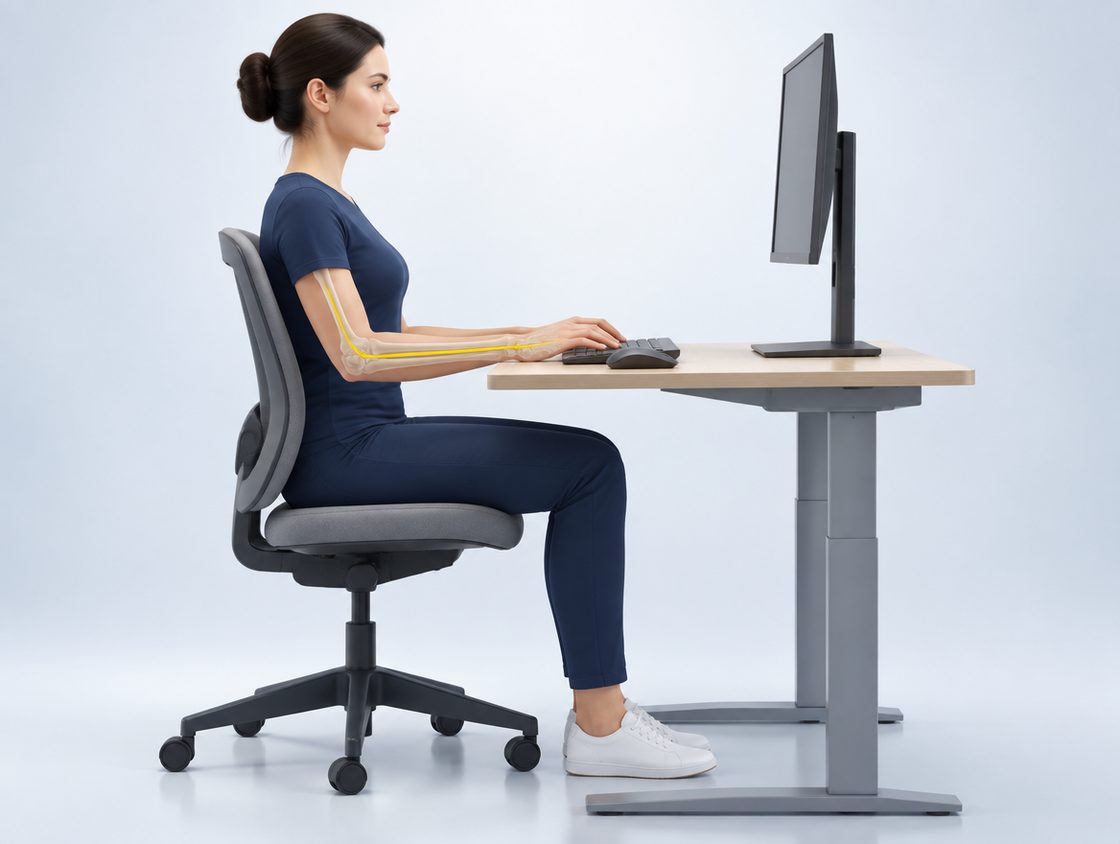
Small changes to everyday hand habits can help reduce the load on your wrists.
- Keep the keyboard at about elbow height, your wrists straight when typing, and your forearms roughly level with the floor.
- Keep the mouse close to your body, and avoid holding your wrist bent up or to the side for long periods.
- Avoid resting your wrists on hard edges, such as the edge of a desk.
- Avoid keeping your wrist bent for long periods when using your phone; use voice input more.
- Take a short break every 30 to 60 minutes to stretch your fingers and wrists.
- Avoid sleeping with your wrists bent under a pillow or your body.
- Don't grip harder than you need to, and use suitable tools to help.
When to seek medical attention promptly
Seek medical attention promptly if any of the following apply:
- Thinning of the muscles at the base of the thumb, or lasting thumb weakness
- Numbness that doesn't go away, or gets worse quickly
- Severe pain, swelling or deformity after a wrist injury
- Numbness that spreads beyond the hand, or affects both hands and both feet
- Neck pain with arm weakness
Frequently asked questions
Can carpal tunnel syndrome go away on its own?
Some mild cases improve once the triggers are reduced; for example, symptoms linked to pregnancy usually fade after delivery. But long-term pressure on the nerve can cause permanent damage, so lasting symptoms should be assessed early.
Do I need surgery?
Not necessarily. Mild to moderate cases usually try non-surgical treatment first. If there is muscle wasting, constant numbness, or no improvement after non-surgical treatment, consult an orthopaedic doctor about whether surgery is needed.
Is “mouse hand” the same as carpal tunnel syndrome?
“Mouse hand” is an everyday term for wrist discomfort from long hours at a computer. It may be carpal tunnel syndrome, or another problem such as tendon strain; an examination is needed to tell them apart.
What should I do about numb hands in pregnancy?
Fluid retention in late pregnancy can press on the median nerve, and symptoms usually fade after delivery. In the meantime, you can adjust your hand habits and sleeping position; if symptoms are marked, talk to your obstetrician first.
How many sessions will I need?
It depends on the severity, how long you have had symptoms, and whether the neck is involved. Dr. Ho will discuss an expected treatment plan with you after your first examination.
Will the Voluntary Health Insurance Scheme (VHIS) cover carpal tunnel syndrome treatment?
That depends on your policy terms. Cover for surgery, outpatient care and chiropractic treatment varies between policies, so check with your insurer before your visit. We are happy to provide receipts to support your claim.
Disclaimer
This page is general information only, not a diagnosis or treatment advice. If you have any symptoms, please consult a qualified healthcare professional.